
Dog Love

She was adorable: a golden coat with the faintest hint of a shepherd’s dark markings under the fur. Her ears flopped in that adorable puppy way, and she had the tiniest white teeth. She had a bit of a silly look as well: her golden hair gave way to black about a third of the way down her tail. It looked like a Dog Man cartoon, only, it was her tail that may have gotten switched with another. It was dog love at first site.
She was calm, surprisingly calm for a puppy of only three months. She was being picked up and carried to us, and she leaned into her human carrier as if on a boat that she expected would lurch at any moment. She was very sweet, friendly, and with a wagging tail, but her eyes were fearful.
Ellis, they had temporarily named her. Abandoned with her sister in a cardboard box, she had no other home, and so I was taking her to foster – a thrilling proposal for my kids. Ellis had been named after the Statue of Liberty…Ellis Island. Because, I was told, when she went outside, she would go still, like a statue.
This was my first red flag.

As biological animals, both dogs and humans have very sensitive nervous systems. It helps us learn. Helps us stay safe and alive. We take in millions of sensations and experiences every day. Our nervous system sorts that data, filters the noise, and inputs the memories that help us become more safely integrated in our worlds – physically and socially. When we can do this safely and securely, our mental well-being flourishes.
Trauma can wreak havoc on our nervous systems. It is a state of psychological overwhelm, where we can no longer effectively process our sensory experiences. It occurs when we are already in an activated “survival” state, not as a consequence of that state but because our environments have overloaded us. Trauma can have substantial long-term effects on the brain, leading to vigilance, hyperactivity, and sensitivity, and reducing emotional regulation and decision-making skills.
Have you ever asked too much of a computer, seen the screen go blank, and sometimes – in the worst-case scenario – the entire computer crashes? It’s the same idea with trauma. And, like with your computer, you want to stop the crashes – because they can hurt the hard drive.
For our little Ellice, I suspected this was what was happening: this puppy was trying to survive, and the sensation of a leash may be all it took to trigger a “flight” response so overwhelming that it was shutting her system down. She was literally “frozen”.

So, I got her a harness.
I was going to need to lead her to keep her safe, and I did not want a sensation of pressure on her throat to start her moving into overwhelm.
I needed to decrease the sensory overload in any way I could, while still keeping her physically safe, and while re-introducing her to previously uncomfortable sensations – crucial for her healing.

We all have two main nervous system branches: the parasympathetic system, where you can relax, heal, and digest; and the sympathetic system, which is where your fight-or-flight responses live. This system comes alive when you need blood to your vital organs, like your heart, your lungs, and to your extremities, like your legs. This system aims to recognize and remove danger.
We used to think the sympathetic nervous system operated like a light switch, flipping us into either fight or flight. Then the science evolved, and “freeze” was added – but even that term is misleading. “Freeze” sounds like shutting down, but most freeze responses aren’t a collapse. A former mentor once told me to think of the trio not as “Fight, Flight or Freeze”, but as “Fight, Flight, or Assess”. I think of it like this:
Assess is active. It is NOT shut down. It is information seeking – figuring out how to survive before acting.
“Assess” is engaged, functional, and intelligent. It is paying very close attention. “Assess” is also where anxiety can live: the body is scanning, threat detection is heightened, and the human (or animal) is seeking information and predicting danger. And yet, Assess is also the threshold that leads toward our relaxed parasympathetic system – the place where safety, learning, and healing can take root.
We can also truly “Freeze”. Freezing, however, looks very different. It is Overwhelm. It is shut down. It is a loss of functional control. Panic Anxiety belongs here: it is the mirror image of Freeze. Panic signals sympathetic overwhelm; freeze signals dorsal vagal overwhelm. Both reflect a system pushed past its capacity.
In my mind, Ellis was Freezing – not assessing – and that was not good.
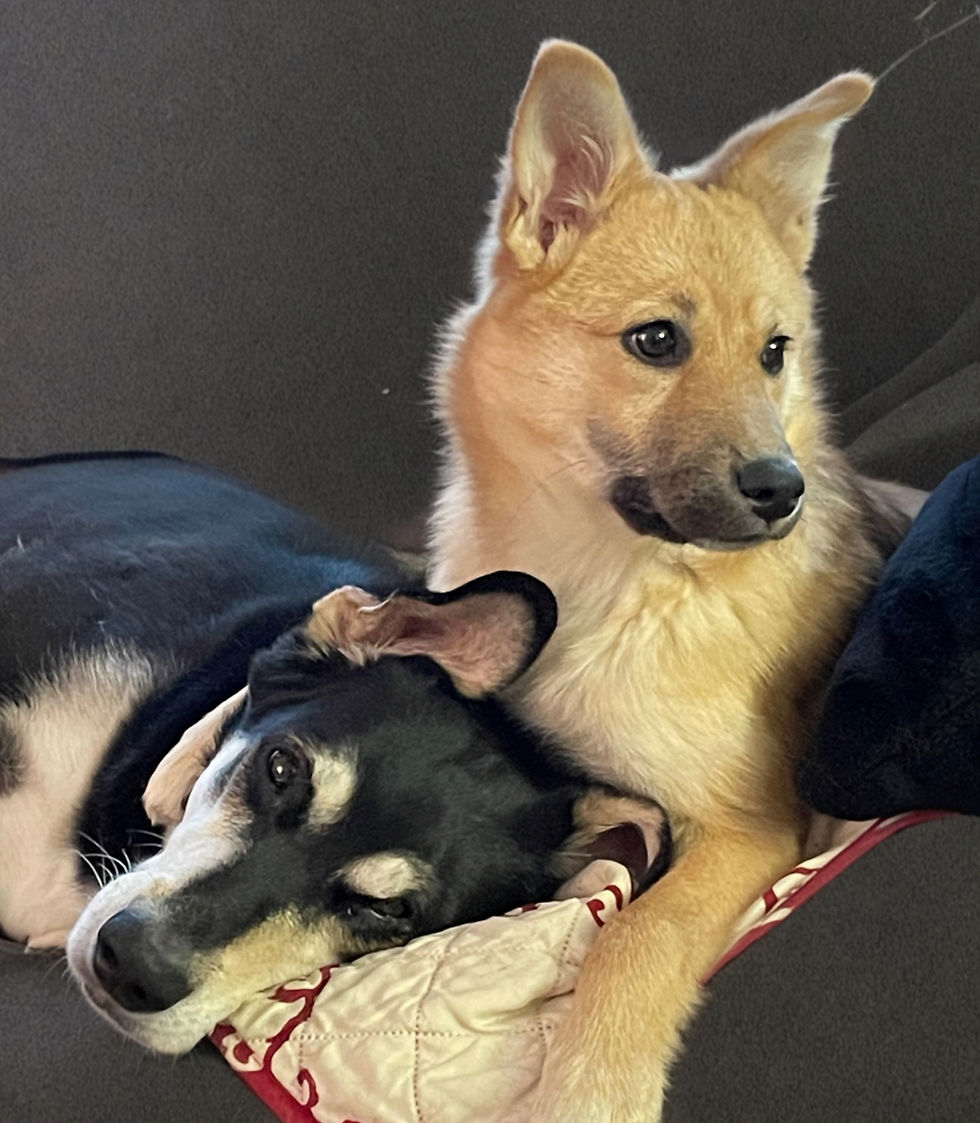
So I slowed everything down.
I let her explore the world at her own pace. I didn’t drag, coax, or force. I stayed close, stayed calm and somewhat disinterested, and waited for her to relax. And, little by little, one step at a time, her nervous system began to shift from Overwhelm, back to Assess.
I am loving the little wins.
She ran away – into the house - when we tried to take her for a walk. She could not cross the threshold of my door. I tried to nudge her along, but that did not help. So, we dropped the leash, and I sat at my back door while my kids and my dogs began their walk. She needed 30 seconds before she was out that door!
She yelped and ran when my dog tried to play with her. Yet over time, and without pressure, she returned to the playsite… and reconnected with her playmate.
She used to run from me each time I called her name. Now, her name is beginning to be associated with food, and pets, and – each time I sit rather than chase – she gets to learn that she is safe with me. And she comes, slowly, but faster each time.

This is the heart of trauma recovery: not forcing calm or avoiding fear, but creating a space where learning and safety can grow together.

Comments